 EN

Building a hydroponic farm involves more than choosing growing channels or nutrient tanks. Your greenhouse structure, crop selection, irrigation system, and climate controls must work together to support consistent production. Whether you are planning a small leafy-green operation or a large commercial farm, understanding these connections helps you avoid costly design changes. Explore greenhouse solutions for hydroponics and commercial multi-span film greenhouses to understand how the growing space can support your production plan.
What Is Hydroponic Greenhouse Farming?
Hydroponic greenhouse farming is a soilless growing method that combines a greenhouse structure with a system for delivering water and dissolved nutrients directly to plant roots. Instead of relying on field soil, plants grow in nutrient solutions or inert media such as coco coir, perlite, rockwool, or expanded clay.
The two parts perform different functions:
-
The hydroponic system supplies water, nutrients, and oxygen to the root zone.
-
The greenhouse provides a protected growing space where light, temperature, humidity, and airflow can be managed.
A greenhouse does not automatically create ideal growing conditions. Its performance depends on the structure, covering material, ventilation openings, shading, and any heating or cooling equipment installed.
For commercial growers, combining these elements can make production more manageable, especially where outdoor weather, seasonal changes, or limited land restrict growing schedules. However, the right design depends on the crop, local climate, production scale, and available resources.
What Crops Can You Grow in a Hydroponic Greenhouse?
Many vegetables, herbs, and selected fruit crops can be grown hydroponically. The most suitable choice depends on root structure, plant size, growing cycle, market demand, and the level of management your farm can provide.
Leafy Greens and Herbs
Lettuce, spinach, kale, basil, mint, and other leafy crops are common choices for hydroponic production. Their relatively compact growth habits make it easier to arrange plants in channels, floating rafts, or growing benches.
NFT and deep water culture (DWC) are frequently considered for these crops. They can support organized planting layouts, but growers still need to monitor water temperature, dissolved oxygen, nutrient concentration, and root health.
Fruiting Vegetables
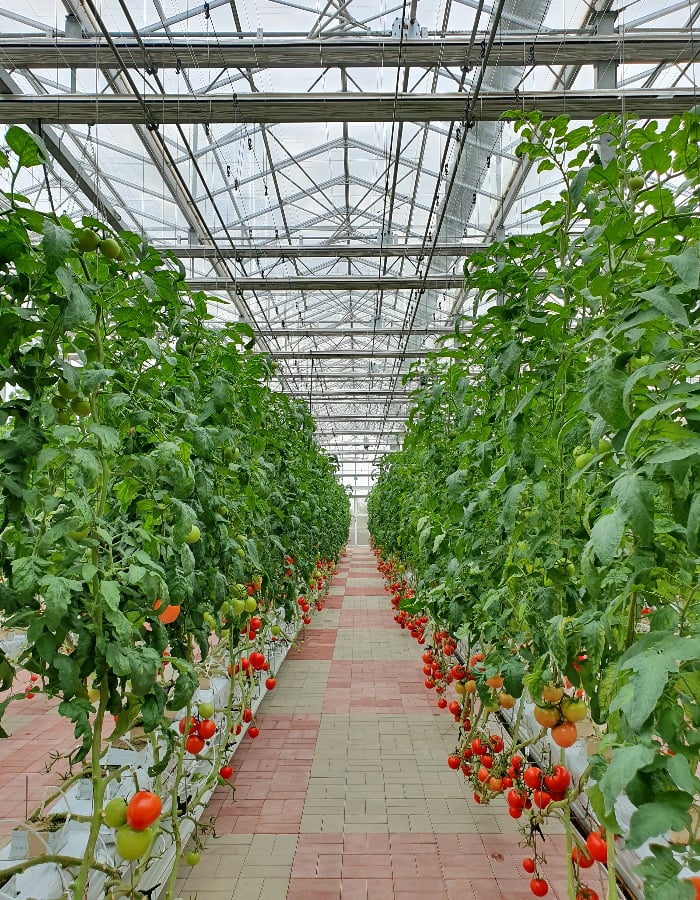
Tomatoes, cucumbers, peppers, and eggplants can also be cultivated in hydroponic greenhouses. Unlike many leafy crops, these plants need more vertical space, stronger support systems, and room for pruning, training, pollination, and harvesting.
Drip irrigation with a growing medium or Dutch Bucket systems are common options. The greenhouse layout should account for plant height, trellis wires, irrigation lines, drainage, and worker access.
Strawberries and Other Specialty Crops
Strawberries can be grown in substrate-based systems, elevated gutters, or specially designed growing channels. These arrangements can make harvesting and plant maintenance more convenient, but they require careful attention to root-zone moisture, drainage, ventilation, and fruit quality.
Before selecting a crop, compare its market demand with your greenhouse capacity and operating experience. A crop that performs well in one region may require different temperature, lighting, or disease-management strategies elsewhere.
| Crop group | Common system options | Important planning requirements |
|---|---|---|
| Lettuce and leafy greens | NFT, DWC, Ebb and Flow | Plant spacing, water circulation, oxygen, and temperature |
| Herbs | NFT, DWC, substrate drip | Harvest access, light distribution, and nutrient management |
| Tomatoes | Dutch Bucket, substrate drip | Plant support, vertical clearance, drainage, and irrigation |
| Cucumbers | Dutch Bucket, substrate drip | Trellis layout, plant spacing, airflow, and pruning access |
| Peppers | Substrate drip, Dutch Bucket | Root-zone management, plant support, and crop spacing |
| Strawberries | Substrate gutters, drip irrigation | Gutter height, drainage, harvesting access, and humidity |
Which Hydroponic System Is Best for Your Farm?
There is no single hydroponic system that works best for every farm greenhouse. The right choice depends on crop requirements, production scale, water management, labor availability, and the complexity you can maintain.
Nutrient Film Technique (NFT)
NFT systems circulate a shallow film of nutrient solution through slightly sloped channels. Plant roots extend into the channels and absorb water and nutrients as the solution flows past them.
NFT is commonly used for lettuce, herbs, and other lightweight leafy crops. It supports organized planting layouts and recirculation, but the system depends on reliable pumps, suitable channel slopes, and unobstructed return lines.
A pump failure or blocked channel can interrupt nutrient delivery quickly. Plan access for cleaning and inspection rather than placing channels too close together.
Deep Water Culture (DWC)
In DWC systems, plant roots are suspended in nutrient-rich water. Air pumps and diffusers supply oxygen to the solution, helping roots maintain the conditions needed for healthy growth.
DWC is often suitable for lettuce and other compact leafy crops. Commercial designs need enough reservoir capacity, reliable aeration, and a way to monitor water temperature and solution quality.
Drip Hydroponics
Drip systems deliver nutrient solution through pipes and emitters to individual plants growing in a substrate. Depending on the design, excess solution may be collected and reused or discharged.
This method is widely used for greenhouse tomatoes, cucumbers, peppers, and other larger crops. It allows growers to manage irrigation for individual plants or growing zones, but filters, emitters, pipes, and drainage outlets need regular inspection.
Dutch Bucket Systems
Dutch Bucket systems use individual growing containers connected to shared irrigation and drainage lines. Nutrient solution is delivered through drip emitters, while excess solution can return to a collection tank in a recovery design.
They are often considered for larger fruiting crops that need more root space and individual growing containers. When planning the greenhouse, leave enough room for buckets, plant supports, pipe connections, and harvesting operations.
Ebb and Flow Systems
Also known as flood and drain, this method periodically floods a growing tray or bench with nutrient solution before draining it back into a reservoir. The growing medium retains moisture while air returns to its pores during drainage.
It can be used for propagation, herbs, and selected leafy crops. The system needs dependable timers, level growing surfaces, suitable drainage, and a well-planned overflow arrangement.
Aeroponics
Aeroponic systems suspend plant roots in an enclosed space and deliver nutrient solution as a fine mist. The roots receive moisture and nutrients without being continuously submerged in water.
This approach requires precise misting, dependable pumps, and careful maintenance of spray nozzles. If misting stops, exposed roots can dry quickly. It may suit specialized production, but the equipment and operating requirements should be evaluated before choosing it for a large commercial project.
| System | Common crop applications | Main planning consideration |
|---|---|---|
| NFT | Lettuce, leafy greens, herbs | Channel slope, pump reliability, and return flow |
| DWC | Lettuce, compact leafy crops | Reservoir size, aeration, and water temperature |
| Drip | Tomatoes, cucumbers, peppers | Emitters, growing media, and drainage |
| Dutch Bucket | Tomatoes, cucumbers, peppers | Container layout, support, and return lines |
| Ebb and Flow | Herbs, propagation, selected leafy crops | Flooding schedule and drainage |
| Aeroponics | Selected leafy crops and specialty production | Misting reliability and nozzle maintenance |
How Do You Plan a Greenhouse for Hydroponic Farming?
A hydroponic greenhouse should be designed around the growing system and crop layout rather than treating the structure as an empty building. Planning these elements together can reduce installation conflicts and make daily operations easier.
Choose the Greenhouse Structure
The greenhouse type should match the project size, local weather, covering material, and environmental-control requirements.
-
Multi-span film greenhouses can provide connected growing areas for commercial production. Their layout can accommodate planting zones, irrigation networks, and service aisles.
-
Venlo glass greenhouses are often considered for commercial projects requiring a structured glass-roof layout and integrated environmental systems.
-
Gothic greenhouses have a peaked roof profile that can provide additional overhead space, depending on the design and dimensions.
-
Single-span greenhouses may suit smaller farms, trial production, or projects with separate growing zones.
No structure is automatically the best option for every hydroponic farm. Compare the required clearances, ventilation design, drainage, covering material, local wind and snow loads, and installation conditions before making a decision.
Explore greenhouse systems to compare structural options for different growing environments.
Plan the Internal Layout
The internal arrangement should allow crops, equipment, and workers to operate without obstructing one another.
Consider these areas before construction:
-
Growing zones for NFT channels, benches, buckets, or substrate gutters
-
Main and secondary access aisles for planting, inspection, and harvesting
-
Reservoirs, pumps, filters, and nutrient-mixing areas
-
Irrigation supply and return pipelines
-
Drainage routes and a suitable water-management area
-
Space for electrical equipment and control panels
-
Storage and maintenance access
For larger farms, divide the greenhouse into manageable growing zones. This can make it easier to operate different crops or planting schedules without requiring every area to use the same irrigation settings.
Consider Height, Span, and Future Expansion
Greenhouse height and span affect how equipment and crops fit inside the structure. Tall fruiting crops may need overhead support wires, while vertical growing arrangements require careful consideration of light distribution and maintenance access.
The design should also leave room for future expansion where possible. Adding growing channels or buckets later can be difficult if the original layout leaves insufficient space for pipelines, service aisles, or drainage.
What Equipment Does a Commercial Hydroponic Greenhouse Need?
A commercial hydroponic farm needs equipment for nutrient delivery, water management, climate control, and crop monitoring. The exact package depends on the chosen growing system and production targets.
| Equipment group | Main components | Purpose |
|---|---|---|
| Water storage and supply | Water tanks, reservoirs, pumps | Store and circulate water |
| Filtration | Water filters, screens, treatment equipment where required | Reduce particles and manage water quality |
| Irrigation and fertigation | Pipes, valves, emitters, dosing equipment | Deliver water and nutrients |
| Root-zone management | Air pumps, diffusers, drainage lines | Support oxygen supply and water movement |
| Monitoring | pH and EC meters, temperature sensors | Track nutrient solution conditions |
| Climate control | Fans, vents, cooling or heating equipment | Manage temperature and airflow |
| Light management | Shade screens, supplemental lights where needed | Adjust light exposure |
| Automation | Controllers, sensors, timers | Coordinate irrigation and environmental equipment |
Equipment should be selected as a connected system. For example, a drip-irrigated tomato greenhouse needs compatible reservoirs, filters, dosing equipment, emitters, drainage, and crop supports. An NFT installation has different channel, slope, pump, and return-flow requirements.
Do not purchase automation equipment before defining what needs to be controlled. Start with the required functions, then determine which operations should be monitored or automated.
How Do You Control the Growing Environment?
Hydroponic production depends on both the greenhouse climate and the conditions around plant roots. Managing one without considering the other can lead to inconsistent growth.
Temperature and Ventilation
High temperatures can increase plant water demand and affect nutrient uptake. Poor airflow can also allow heat and humidity to accumulate around dense crops.
Natural ventilation through roof and side openings can help exchange indoor and outdoor air. Its effectiveness depends on opening size and position, greenhouse orientation, wind conditions, temperature differences, and surrounding obstacles.
In hot or humid regions, additional cooling or mechanical air circulation may be necessary. In colder regions, heating and insulation requirements need to be considered alongside ventilation.
Light and Shading
Plants need sufficient light for photosynthesis, but excessive solar radiation can increase greenhouse temperatures and stress sensitive crops.
The appropriate approach depends on crop type, season, greenhouse covering, and local sunlight conditions. Shade systems can reduce excessive solar exposure, while supplemental lighting may be needed when natural light is insufficient.
For vertical growing systems, check whether light reaches all growing levels evenly. A layout that works for one horizontal layer may create uneven exposure when additional tiers are installed.
Water Quality and Nutrient Management
Hydroponic plants depend on the nutrient solution for essential minerals. Water quality, pH, and electrical conductivity (EC) therefore need regular monitoring.
-
pH indicates how acidic or alkaline the solution is and affects nutrient availability.
-
EC provides an overall indication of dissolved salts in the solution.
-
Dissolved oxygen supports root respiration, particularly in systems where roots remain in or near nutrient solution.
-
Water temperature affects oxygen availability and root-zone conditions.
Target values should be set according to the crop, growth stage, nutrient formulation, and water source. A leafy-green reference range should not automatically be applied to tomatoes, cucumbers, or other crops.
Humidity and Air Movement
High humidity and stagnant air can increase disease pressure, especially in dense canopies. Ventilation, appropriate plant spacing, and air circulation help reduce persistent damp conditions.
Insect screens may help limit pest entry through ventilation openings, but they also affect airflow. Their mesh size and installation should be considered together with the ventilation design.
What Should You Consider Before Investing in a Hydroponic Greenhouse?
A successful project starts with a realistic production plan. Before selecting a farm greenhouse, evaluate the following factors.
-
Target crops: Identify the crops, varieties, planting density, growing cycles, and expected harvest schedule.
-
Local climate: Assess seasonal temperatures, sunlight, humidity, wind, rainfall, and snow conditions where relevant.
-
Water supply: Check water availability, quality, treatment needs, and drainage arrangements.
-
Power supply: Confirm that the site can support pumps, controllers, lighting, fans, and heating or cooling equipment.
-
Production scale: Estimate the growing area, number of plants, labor requirements, and space needed for harvesting and packing.
-
System compatibility: Match the hydroponic method with crop size, root requirements, substrate, irrigation, and drainage.
-
Operating costs: Account for energy, water, nutrients, replacement parts, labor, maintenance, and crop protection.
-
Future expansion: Consider whether the greenhouse can accommodate additional growing zones or equipment later.
Common Purchasing Mistakes to Avoid
-
Choosing a greenhouse based only on its price or appearance without checking crop and climate requirements.
-
Selecting a hydroponic system before deciding which crops the farm will produce.
-
Underestimating the space needed for reservoirs, pipes, drainage, and maintenance access.
-
Installing dense growing layouts without checking light distribution and airflow.
-
Treating automation as a substitute for regular inspection and maintenance.
-
Assuming that all hydroponic systems can use the same nutrient solution settings.
-
Ignoring local structural requirements for wind, snow, foundations, and site conditions.
A detailed project plan should coordinate the greenhouse supplier, hydroponic system designer, irrigation provider, and local engineering requirements before installation begins.
Frequently Asked Questions
1. Is a greenhouse necessary for hydroponic farming?
No. Hydroponics can operate indoors or outdoors, but a greenhouse provides shelter and a space for managing growing conditions.
2. What is the easiest hydroponic system for beginners?
DWC is often straightforward for small leafy-green trials. Commercial projects need a system matched to crop and operating requirements.
3. Can tomatoes grow in a hydroponic greenhouse?
Yes. Tomatoes are commonly grown in substrate-based drip systems or Dutch Buckets, with suitable plant supports and climate management.
4. Can hydroponic greenhouses operate year-round?
They can, if local conditions and equipment support the crop's temperature, light, and water requirements throughout the year.
5. Does hydroponic farming require soil?
No. Plants receive nutrients through water, with some systems using inert growing media to support the roots.
6. What is the difference between NFT and DWC?
NFT moves a thin stream of nutrient solution through channels, while DWC suspends roots in an aerated nutrient reservoir.
7. How do you prevent root diseases in hydroponic systems?
Maintain clean equipment, suitable water temperature, adequate oxygen, and reliable circulation. Inspect roots and nutrient solution regularly.
Final Thoughts
Successful hydroponic greenhouse farming depends on matching the crop, growing system, greenhouse structure, and environmental controls. Before investing, define your production goals and evaluate local climate, water, power, layout, and maintenance requirements. FZY provides greenhouse solutions for hydroponic farming to help align greenhouse structures with different commercial growing plans. Contact FZY at [email protected] to discuss your project requirements.
Table of Contents
- What Is Hydroponic Greenhouse Farming?
- What Crops Can You Grow in a Hydroponic Greenhouse?
- Which Hydroponic System Is Best for Your Farm?
- How Do You Plan a Greenhouse for Hydroponic Farming?
- What Equipment Does a Commercial Hydroponic Greenhouse Need?
- How Do You Control the Growing Environment?
- What Should You Consider Before Investing in a Hydroponic Greenhouse?
-
Frequently Asked Questions
- 1. Is a greenhouse necessary for hydroponic farming?
- 2. What is the easiest hydroponic system for beginners?
- 3. Can tomatoes grow in a hydroponic greenhouse?
- 4. Can hydroponic greenhouses operate year-round?
- 5. Does hydroponic farming require soil?
- 6. What is the difference between NFT and DWC?
- 7. How do you prevent root diseases in hydroponic systems?
- Final Thoughts