 EN

Greenhouse Structure Types: Which is Best for Commercial Growers?
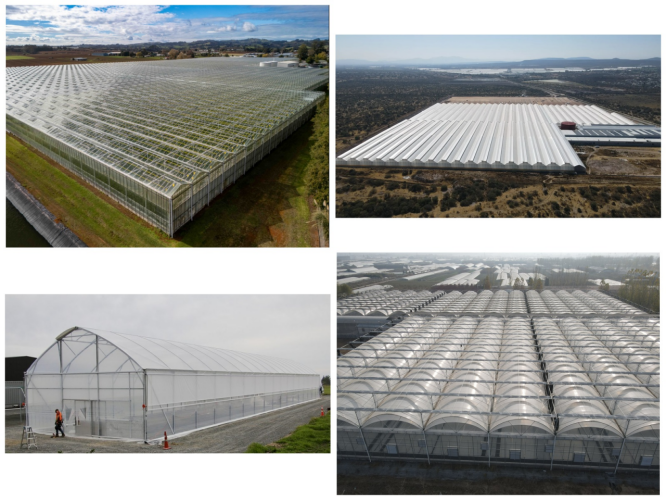
Choosing a greenhouse structure is one of the most critical decisions in a commercial growing project. Roof shape, covering materials, and structural layout all influence available growing space, ventilation, installation requirements, and long-term operating costs.
The best choice isn't always the most advanced or cheapest greenhouse, but rather the structure best suited to the crop, climate, cultivation methods, production scale, and budget. Understanding the available greenhouse structure types can help growers narrow down their options before developing detailed project designs.
This guide compares four common greenhouse types—Gothic multi-span greenhouses, glass greenhouses, tunnel greenhouses, and multi-span film greenhouses—to help commercial growing clients understand the differences between these structures and determine and select the appropriate type based on their growing needs and project conditions.
1. Four Main Types of Greenhouse Structures
Greenhouses can be classified in several ways: roof shape, whether the spans are connected, and the covering material. These classifications are not mutually exclusive. For example, a Gothic multi-span greenhouse can also be covered with a film. For the convenience of commercial growers, the following four classifications reflect actual product choices rather than four completely independent engineering categories.
1.1Gothic Multi-Span Greenhouse
https://www.fzygreenhouses.com/gothic-multispan-greenhouse
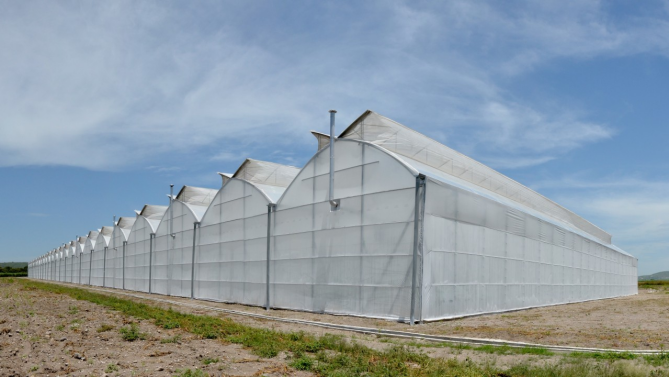
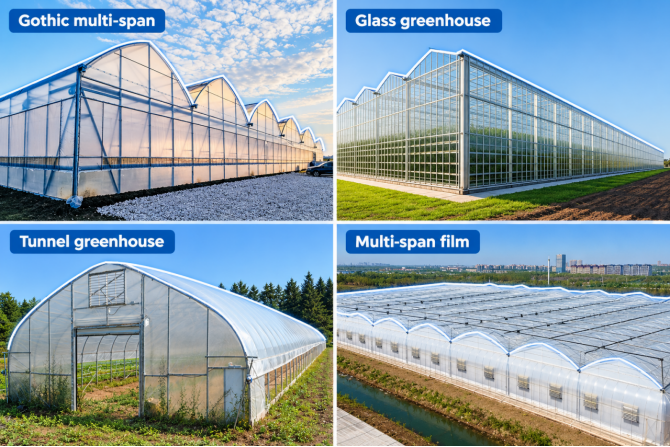
A Gothic multi-span greenhouse combines a pointed-arch roof with several connected bays. The shared-gutter layout creates a continuous production area, while the pointed roof distinguishes it from conventional rounded-arch designs. Frames are commonly made from galvanized steel and can support suitable film coverings and growing systems.
Structural characteristics and advantages:The pointed roof promotes drainage toward the gutters. With properly designed gutter heights and structural clearances, the greenhouse can accommodate tall crops, overhead trellising, internal walkways, and growing equipment. Connected spans also make it easier to coordinate production across a larger area.
Limitations to consider: A Gothic multi-span structure generally requires more engineering and site planning than a basic single tunnel. Gutters, foundations, connections, and ventilation openings must be designed for local wind, rain, and snow loads. Roof geometry alone does not establish a structure's weather resistance or ventilation performance.
Typical applications:This configuration is worth considering for tomatoes, cucumbers, peppers, strawberries, and other commercial crops, particularly where growers need continuous planting space and adequate vertical clearance.
1.2 Glass Greenhouse
https://www.fzygreenhouses.com/glass-greenhouse
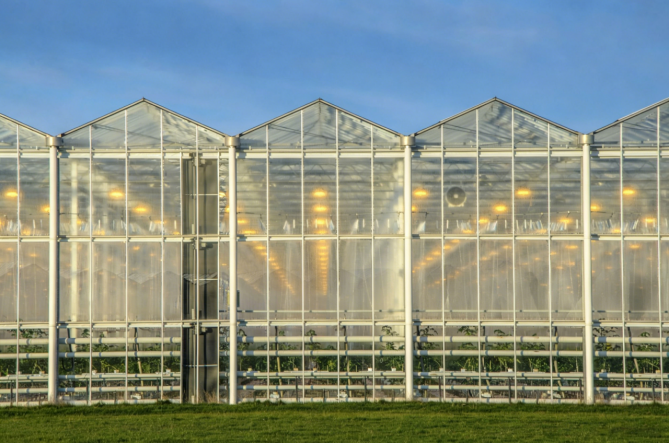
A glass greenhouse is defined primarily by its covering material, rather than by one specific roof shape. Commercial glasshouses may use gable or Venlo-style roof systems supported by engineered steel or aluminum framing.
Structural characteristics and advantages:Suitable horticultural glass can provide high light transmission and a long service life. The glazing and structural framework can be designed to accommodate roof vents, thermal and shading screens, heating and cooling equipment, fertigation, and environmental monitoring. Actual light levels depend on the glass specification, structural shading, orientation, and local conditions.
Limitations to consider:Glasshouses generally involve higher initial investment than basic film-covered structures of comparable size. Glazing, foundations, support frames, installation, and climate systems add to the project scope. Energy use also needs careful assessment: glass alone does not guarantee a stable growing environment.
Typical applications:Glass greenhouses are frequently considered for high-value vegetables, flowers, propagation, hydroponic production, and projects where precise environmental control is a priority. They can also be configured for different levels of automation according to investment and operational needs.
1.3 Tunnel Greenhouse
https://www.fzygreenhouses.com/tunnel-greenhouse
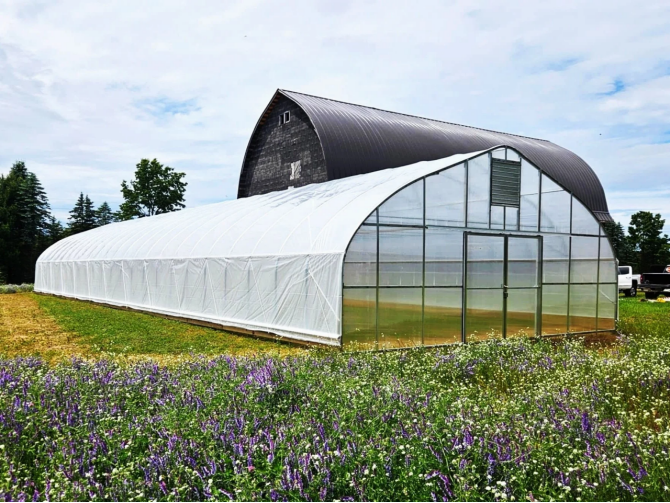
A tunnel greenhouse typically has a single curved roof formed by a series of hoops, often made from galvanized steel and covered with polyethylene film. Many are also described as hoop houses or high tunnels, although the terms can differ according to the installation and level of climate control.
Structural characteristics and advantages: A basic tunnel uses a relatively straightforward framework and can be quicker to install than a more complex connected greenhouse. Depending on the design, it may include roll-up sides, end ventilation, insect screens, and irrigation equipment. Separate tunnels also allow growers to divide crops into individual growing areas.
Limitations to consider:Low-profile tunnels can provide less usable clearance near the sidewalls. This can restrict tall crops, overhead systems, and equipment access. Basic tunnels may rely heavily on natural ventilation and may need reinforcement or additional protection where wind and snow loads are significant.
Typical applications:Tunnel greenhouses can suit leafy vegetables, strawberries, nursery crops, and seasonal vegetable cultivation when simple crop protection and a manageable initial investment are the main priorities.
1.4Multi-Span Film Greenhouse
https://www.fzygreenhouses.com/circular-multispan
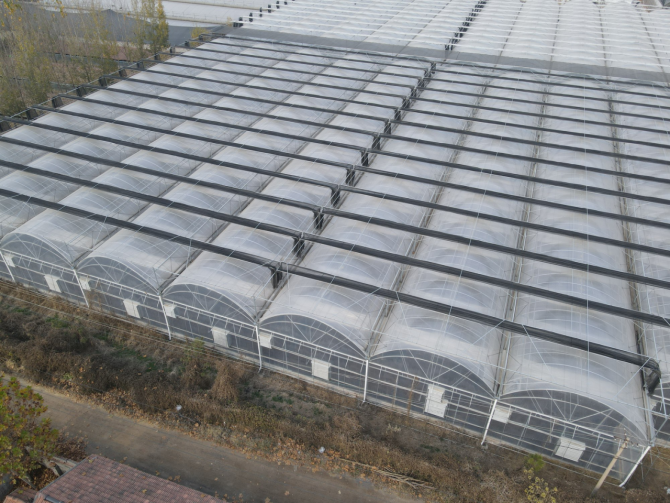
A multi-span film greenhouse connects several bays through shared gutters and supporting frames, with polyethylene film as the principal covering material. Multi-span film structures can have rounded or pointed roofs. In this comparison, the category primarily refers to conventional rounded-arch multi-span film designs, as distinct from the Gothic models above.
Structural characteristics and advantages:The connected interior gives growers room for planting rows, service paths, irrigation lines, and centralized crop management. Film coverings are lightweight and generally have a lower initial material cost than glass, although the total cost depends on the structure and installed systems. Roof or side vents, shading, cooling, and irrigation equipment can be integrated where needed.
Limitations to consider:Ventilation and temperature distribution become increasingly important as the connected production area grows. Designers must also consider drainage at shared gutters, structural loads, and periodic film replacement. A larger footprint is not automatically more efficient without a suitable crop and management plan.
Typical applications: Multi-span film greenhouses are often considered for commercial vegetables, flowers, berries, and nursery production where growers want a large connected growing area and flexibility in system configuration.
2. Types of Greenhouse Structures with Pictures: A Quick Comparison
|
Greenhouse type |
Defining feature |
Typical strengths |
Check before choosing |
|
Gothic multi-span |
Connected bays; pointed-arch roof |
Tall-crop clearance; connected work area; roof drainage |
Structural loads, gutter design, vent layout |
|
Glass greenhouse |
Rigid glass covering; variable roof styles |
Durable glazing; light transmission; system integration |
Upfront investment; energy and glazing requirements |
|
Tunnel greenhouse |
Usually a single curved span with film |
Simple construction; individual growing zones |
Sidewall clearance; weather exposure; ventilation |
|
Multi-span film |
Connected bays; film covering, often rounded roofs |
Large working area; flexible equipment options |
Airflow distribution; gutters; film maintenance |
Comparison note: Categories overlap. Performance and cost depend on project dimensions, covering specification, equipment, and local engineering requirements.
https://www.fzygreenhouses.com/products
These four options should not be treated as a ranking from basic to advanced. For example, film-covered greenhouses can also use automated controls, and a glass greenhouse is not necessarily the best option for a hot climate. The correct comparison is between complete project configurations that meet the same growing requirements.
3. How to Choose a Greenhouse Structure Suitable for Commercial Growers
Different types of greenhouse design involve different trade-offs. Before comparing quotations, establish the needs of the growing operation in five areas.
3.1 Crops and Cultivation Methods
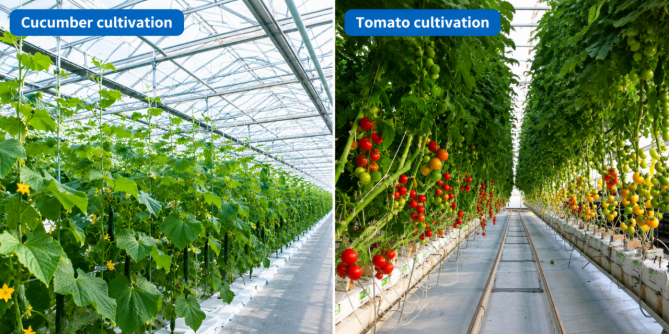
Start with mature crop height, growing density, planting arrangement, and harvesting method. Tomatoes and cucumbers grown on high-wire systems need enough vertical clearance for trellising and crop work. Strawberries may require suitable support for elevated gutters, while seedlings and leafy greens may prioritize bench layout and uniform growing conditions. A greenhouse should be dimensioned around the actual production system, not simply the crop name.
3.2 Local Climate and Structural Loads
Hot locations may require generous ventilation, shading, or evaporative cooling; colder locations may need heating, insulation, and condensation management. Wind, rainfall, and snow loads affect the design of frames, gutters, connections, and foundations. Assessing these site conditions is more reliable than assuming that one roof shape can withstand every climate.
3.3 Growing Area and Expansion
An individual tunnel can be useful for separate crop zones or staged investment. Connected Gothic and multi-span film structures can create larger working areas and simplify movement between bays. Glass greenhouses can also be scaled for commercial facilities. Reserve space for service corridors, storage, water treatment, equipment, and future expansion before finalizing the footprint.
3.4 Initial and Long-Term Costs
Compare complete project costs—not just the price of the steel frame. Foundations, covering materials, installation, ventilation, irrigation, heating or cooling, and controls all influence initial investment. Over time, energy, labor, maintenance, and covering replacement also matter. A lower purchase price does not always mean a lower cost over the intended operating life.
3.5 Systems and Equipment
Roof vents, exhaust fans, shading screens, high-wire crop systems, fertigation equipment, and automation may all affect structural dimensions or load capacity. Planning the structure and supporting systems together reduces the risk of installation conflicts and expensive modifications later.
4. How Greenhouse Structure Affects the Crop Growing Environment
https://www.fzygreenhouses.com/greenhouse-systems
4.1 Ventilation and Airflow
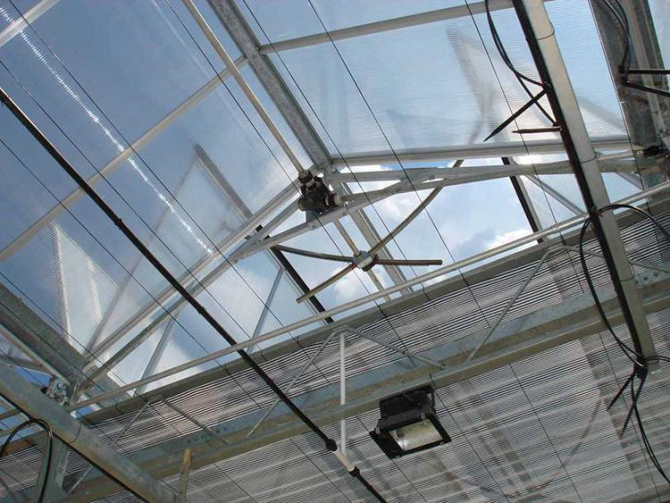
Greenhouse height, width, vent placement, and bay layout affect how outdoor air enters and warm, humid air leaves. Tunnels often use side or end openings; multi-span structures may combine roof and side ventilation. Some projects also require exhaust fans, circulation fans, or fan-and-pad cooling. Performance depends on opening size, the weather, and the completed ventilation design—not on the structure name alone.
4.2 Light and Covering Materials
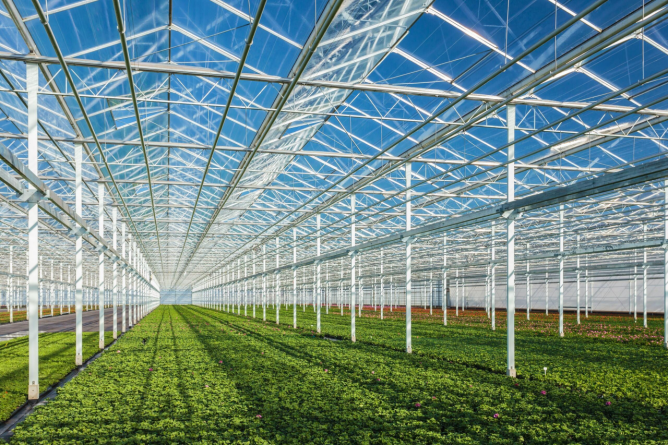
Light transmission depends on the covering, roof geometry, frame shading, greenhouse orientation, and seasonal sunlight. Polyethylene film and horticultural glass have different optical properties, insulation characteristics, maintenance needs, and initial costs. Evaluate the chosen covering and structure as a system rather than treating either as an independent solution.
4.3 Integration with Growing Equipment
A structure must leave enough room and provide suitable support for crops and installed systems. For example, crop wires and shade screens need attachment points and clearances. Irrigation and cooling equipment must fit the planting layout and service access. These factors can be addressed at the design stage regardless of whether the greenhouse is covered with film or glass.
5. Which commercial growing projects are suitable for different greenhouse structures?
5.1 Commercial Vegetable Production
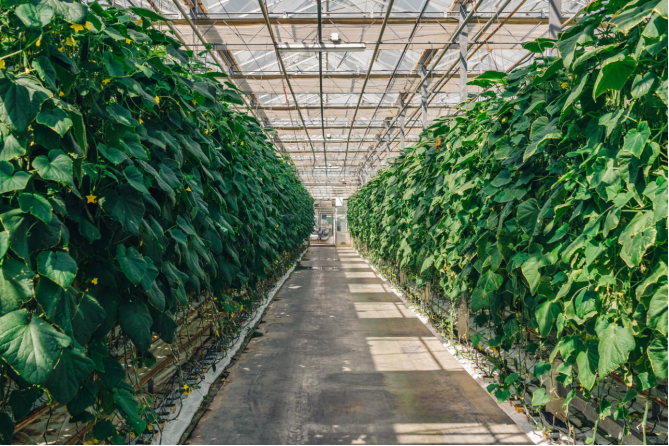
For tomatoes, cucumbers, and peppers, Gothic multi-span and conventional multi-span film greenhouses are common options because they can be designed for crop-support systems and continuous production. Glass greenhouses may be considered when a project calls for more extensive climate-management equipment. Final selection should account for crop height, production method, climate, and total investment.
5.2 Strawberry and Berry Cultivation
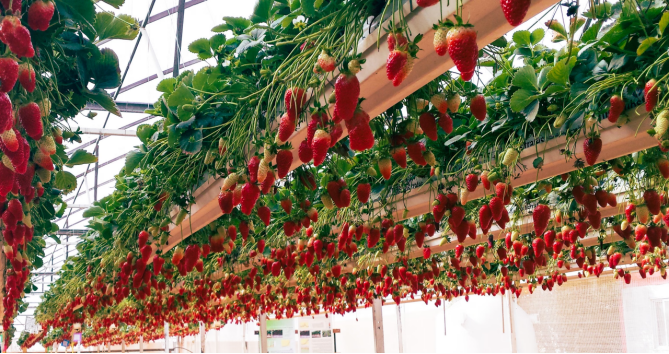
Tunnel structures can offer practical protection for strawberries and low-growing berry crops. Larger berry operations may consider Gothic or multi-span film greenhouses for connected planting areas and elevated cultivation systems. In every case, humidity control, airflow, harvesting access, and support for the chosen growing method should guide the design.
5.3 High-Tech Horticulture and Nurseries
Glass greenhouses are often evaluated for propagation, floriculture, and high-value crops that require closely managed environments. However, film-covered greenhouses can also accommodate automated ventilation, fertigation, and monitoring systems when appropriately designed. The decision should depend on how much environmental control the operation requires and what it can reasonably maintain.
5.4 Projects in Hot or Cold Climates
For hot climates, prioritize a greenhouse design with enough ventilation and a realistic cooling strategy. For cold climates, consider insulation, heating demand, and the required structural load capacity. A tunnel may be appropriate for seasonal production, while year-round projects may justify more extensive systems. Climate should guide the specification rather than dictate one greenhouse category automatically.
6. How FZY Greenhouses Supports Commercial Growing Projects
At FZY Greenhouses, we design and manufacture greenhouse structures for commercial agricultural projects. Our product range includes Gothic multi-span, glass, tunnel, and multi-span film greenhouses, together with related growing systems.
When discussing a new project, we consider the location, crops, cultivation method, planned area, climate-management needs, and investment goals. These details help determine the structural layout and which ventilation, shading, irrigation, cooling, or monitoring systems may be appropriate.
Visit the FZY Greenhouses product range to explore available options.
Need Help Choosing a Greenhouse Structure?
Share your project location, crop type, planned growing area, and production goals with our team. We can discuss suitable structure and system configurations based on those requirements.
Contact FZY Greenhouses to Discuss Your Project
7. Frequently Asked Questions About Greenhouse Structures
What are the most common types of greenhouse structures for commercial growing?
Commercial greenhouses can be classified by roof shape, connected-span layout, or covering material. The four FZY categories discussed here are Gothic multi-span, glass, tunnel, and multi-span film greenhouses. Other designs also exist, so this is a practical product comparison rather than an exhaustive engineering classification.
What is the difference between a Gothic multi-span greenhouse and a multi-span film greenhouse?
Gothic describes the pointed roof profile; multi-span film describes a connected structure covered with film. The categories can overlap. In this article, Gothic multi-span is compared mainly with conventional rounded-arch multi-span film greenhouses to make the roof-shape difference easier to understand.
Which greenhouse structure has the lowest initial cost?
A basic single-span tunnel often has a lower initial construction cost than a large connected or glass-covered facility. However, a fair quotation comparison must use equivalent area, structural standards, covering materials, and system requirements. Long-term operation and maintenance costs may change the result.
Is a glass greenhouse better than a film greenhouse?
Not universally. Glass is a durable covering that can support projects requiring high light transmission and extensive environmental systems, while film coverings can offer lower initial material costs and flexible designs. The most suitable option depends on the project, including its climate, crops, equipment, and budget.
Can one greenhouse structure support different crops?
Yes. The same basic structure can be configured for different crops, but height, ventilation, irrigation, crop-support equipment, and growing layout may need to change. Project-specific configuration is more important than assuming that one structure is suitable for every cultivation method.
How should I choose a greenhouse for my local climate?
Review seasonal temperature, humidity, solar radiation, prevailing winds, rainfall, and any expected snow loads. Then consider crop requirements and available heating or cooling resources. The supplier or engineer should use these conditions to develop a suitable structural and climate-control specification.
Conclusion: Choosing the Right Greenhouse Structure
Understanding the main types of greenhouse structures gives commercial growers a stronger starting point for project planning. Gothic multi-span, glass, tunnel, and multi-span film greenhouses provide different combinations of roof geometry, covering materials, growing space, and equipment options.
Rather than selecting a greenhouse on appearance or frame price alone, compare the complete design against the crops, local climate, cultivation method, budget, and long-term operating plan.
Table of Contents
- Greenhouse Structure Types: Which is Best for Commercial Growers?
- 1. Four Main Types of Greenhouse Structures
- 1.3 Tunnel Greenhouse
- 2. Types of Greenhouse Structures with Pictures: A Quick Comparison
- 3. How to Choose a Greenhouse Structure Suitable for Commercial Growers
- 3.1 Crops and Cultivation Methods
- 3.2 Local Climate and Structural Loads
- 3.3 Growing Area and Expansion
- 3.4 Initial and Long-Term Costs
- 3.5 Systems and Equipment
- 4. How Greenhouse Structure Affects the Crop Growing Environment
- 4.1 Ventilation and Airflow
- 4.2 Light and Covering Materials
- 4.3 Integration with Growing Equipment
- 5. Which commercial growing projects are suitable for different greenhouse structures?
- 5.1 Commercial Vegetable Production
- 5.2 Strawberry and Berry Cultivation
- 5.3 High-Tech Horticulture and Nurseries
- 5.4 Projects in Hot or Cold Climates
- 6. How FZY Greenhouses Supports Commercial Growing Projects
- Need Help Choosing a Greenhouse Structure?
- 7. Frequently Asked Questions About Greenhouse Structures
- What are the most common types of greenhouse structures for commercial growing?
- What is the difference between a Gothic multi-span greenhouse and a multi-span film greenhouse?
- Which greenhouse structure has the lowest initial cost?
- Is a glass greenhouse better than a film greenhouse?
- Can one greenhouse structure support different crops?
- How should I choose a greenhouse for my local climate?
- Conclusion: Choosing the Right Greenhouse Structure