 EN

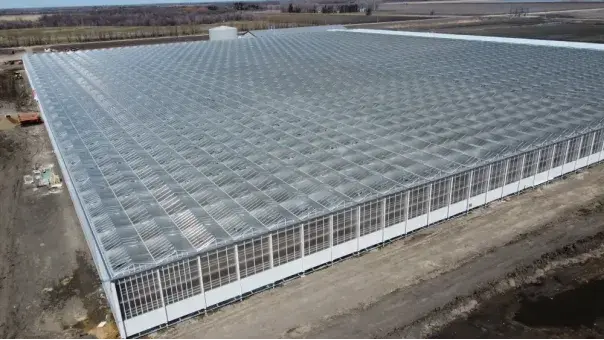
A climate-controlled greenhouse rarely fails because of one weak component. It fails when the systems inside were never designed to work together. Ventilation, cooling, heating, irrigation, lighting, and automation each solve a different problem, yet their capacities depend on each other. This guide explains what greenhouse environmental control systems include and what to settle before you invest.
What Do Greenhouse Environmental Control Systems Include?
Greenhouse environmental control systems are the equipment and controls that hold temperature, humidity, air quality, light, water, and nutrients inside the range your crop needs. They are usually grouped into six areas that affect one another. Heating a house that loses warm air through open vents wastes fuel; running cooling behind a retracted screen wastes water.
Table 1 summarizes each group and the input it needs.
|
System |
What It Manages |
Decided By |
|
Ventilation |
Air temperature, humidity, CO2, air movement |
Opening area, fan capacity, local wind, crop height |
|
Cooling |
Summer temperature peaks |
Design dry-bulb and wet-bulb temperature, water supply |
|
Heating |
Night and winter temperature |
Heat loss, lowest outdoor temperature, crop setpoint |
|
Irrigation and fertigation |
Water, nutrients, root-zone moisture |
Crop demand, substrate, water quality |
|
Lighting |
Light intensity, day length, solar heat gain |
DLI target, natural light, electricity cost |
|
Automation and monitoring |
Coordination of the five systems above |
Zones, sensors, operating strategy, labor |
1. Ventilation: Temperature, Humidity, and Air Exchange
Ventilation removes excess heat and moisture and brings in fresh air. Without it, heat builds up under the covering, humidity stays high after irrigation, and the canopy sits in still air. Those conditions favor condensation and leaf disease.
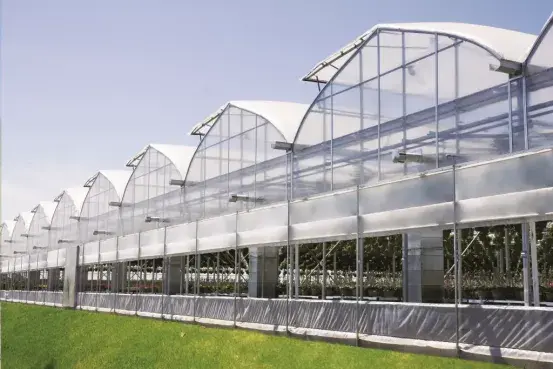
Commercial greenhouse ventilation systems usually combine three approaches: natural ventilation, mechanical ventilation, and internal air circulation.
Natural Ventilation: Roof and Sidewall Openings
Natural ventilation depends on buoyancy and wind. Warm air rises and leaves through roof openings while cooler air enters at the sidewalls or roll-up sides. Wind pressure adds to the effect when it meets the structure at a useful angle.
It is the default for tunnel, Gothic, and multi-span greenhouses because it uses no fan energy. Its performance, however, depends on wind speed, outdoor temperature, and the size and position of the openings.
Design roof and sidewall openings as one system. A large roof vent with small side inlets limits airflow, and average wind speed is not a design condition. Size the openings for the summer days you are willing to tolerate, not for a typical breeze.
ical Ventilation: Exhaust Fans and Inlets
Mechanical ventilation uses exhaust fans to pull air through the house and inlets to replace it. It gives you airflow on still days and in dense, tall crops where buoyancy is weak.
Fan capacity is only half of the design. If inlet area is too small, negative pressure rises, fan output falls, and air enters in fast jets that leave uneven zones. Fan number, size, and placement should follow house volume, target air exchange, and the resistance of the whole air path, filters and louvers included.
Air Circulation Fans: Mixing, Not Exchange
Circulation fans move air inside the house. They break up stagnant pockets, even out temperature and humidity, and keep the air around leaves from staying saturated.
They do not remove heat or moisture. A house with strong internal mixing and closed vents will still overheat, so plan circulation and ventilation together.
Before you invest: compare the air exchange your summer design conditions require with the opening area and fan capacity you have allowed for, and confirm the structure can carry the vent drives and screens you plan.
2. Cooling: Holding Summer Temperatures Down
Ventilation alone often cannot hold temperature on a hot afternoon. Once outside air is as warm as the target, more air exchange stops helping, and you need cooling that lowers the air temperature itself.
Before you specify cooling, check the summer design dry-bulb and wet-bulb temperatures, water supply and quality, and how much humidity the crop tolerates.
Fan and Pad Cooling
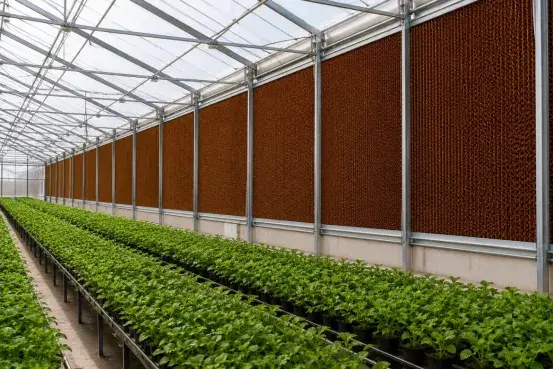
A fan and pad cooling system pulls outside air through wet pads on one wall and exhausts it at the opposite wall. Water evaporating from the pad absorbs heat, so cooler air enters the crop zone.
The gap between dry-bulb and wet-bulb temperature sets the ceiling on how much cooling is available. In hot, dry air that gap is wide; in humid air it may be only a few degrees. Published pad efficiency values come from test conditions, so size the system for your design wet-bulb, not the best figure in a catalog.
Pad area, airflow per square meter, water flow, and water quality all matter. Hard water scales the pad, dust and algae block it, and a pad that dries unevenly cools unevenly.
Fogging and Misting
High-pressure fogging injects fine droplets that evaporate in the air, cooling it and raising humidity. Misting produces larger droplets and suits propagation and crops that benefit from high humidity.
Fogging needs air movement to work. Without fans or open vents, droplets fall onto leaves, and wet foliage in still air is a disease risk. Humidity sensors and staged control matter as much as nozzle quality.
Choosing a Cooling Method for Your Climate
Match the method to your humidity and water supply, not to the greenhouse size alone.
|
Method |
Works Best When |
Main Limitation |
|
Fan and pad |
Hot, dry air with a wide wet-bulb depression |
Output drops as humidity rises; needs water, pad maintenance |
|
High-pressure fogging |
Dry air, tall crops, humidity control also wanted |
Needs air movement; wet foliage risk if poorly staged |
|
Shading screen or whitewash |
Strong radiation, any humidity level |
Cuts light along with heat; not a cooling system on its own |
|
Misting |
Propagation, humidity-loving crops |
Large droplets, uneven distribution |
Many projects combine them: screens to cut the load, ventilation for the first few degrees, and evaporative cooling for the peak.
3. Heating: Stable Night Temperatures
In cold climates, or where day-to-night swings are large, heating protects the crop overnight. Low temperature slows development and limits nutrient uptake.
Heater selection starts with heat loss, not with heater capacity.
Hot Water Heating
A hot water heating system uses a boiler to warm water that circulates through pipes along the walls, under benches, or between rows. Pipe heating spreads warmth evenly and suits large multi-span and multi-zone projects.
Water carries thermal inertia. That steadies temperature but slows response, so pipe layout, zone size, and control strategy need to be designed together.
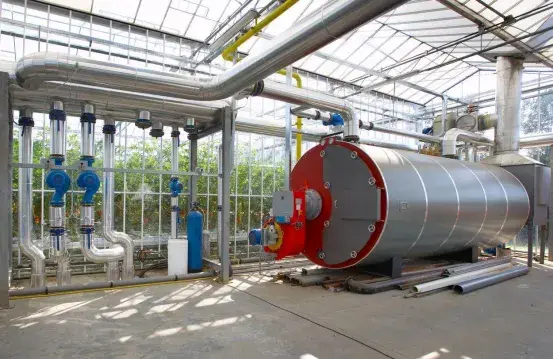
Heaters and Warm Air
Unit heaters warm air directly and distribute it with fans or ducts. They respond quickly and cost less where a central hot water system is unnecessary.
Warm air stratifies. Without circulation fans or perforated ducts, the crop zone runs cooler than the roof space, and the sensor may read a temperature your plants never experience.
Estimate Heat Loss Before Heater Capacity
Heat leaves a greenhouse through the covering, the frame, the floor edge, open vents, doors, and air leakage. Covering choice matters: single-layer film, double-layer inflated film, polycarbonate, and glass each transfer heat differently.
A heat loss calculation should include:
- Lowest outdoor design temperature
- Target indoor temperature for each crop stage
- Covering area and heat transfer value
- Air leakage and minimum ventilation rate
- Thermal screen or energy curtain performance
- Soil or bench heating, if used
Then add a margin for the coldest night and confirm fuel supply and safety devices.
Before you invest: fix the night temperature your crop needs, request a heat loss calculation for the actual covering and climate, and compare seasonal fuel cost rather than heater price.
4. Irrigation and Fertigation: Water and Nutrient Supply
Irrigation in a commercial greenhouse is a delivery system, not a watering can. Timing, volume, and nutrient concentration all affect growth uniformity and quality.
Fixed timers are the most common source of error, because crop water demand follows radiation, temperature, humidity, and growth stage rather than the clock.
Drip Irrigation
Greenhouse drip irrigation delivers water to the root zone of each plant through drip lines or emitters. Compared with overhead watering, it keeps foliage dry and puts water where roots can use it.
Emitter flow rate, spacing, and the number of drippers per plant follow crop spacing, substrate volume, and how widely the root zone should wet. A design that wets only the top few centimeters encourages shallow roots.
Fertigation with EC and pH Control
Fertigation injects nutrient stock into the irrigation line. EC and pH sensors let you hold the solution within a target range instead of mixing by hand.
Sensors drift and injectors wear. Without scheduled calibration, the controller keeps logging numbers while the crop receives something else. Check EC and pH against a handheld meter regularly, and in substrate culture watch drain EC and drain percentage as well.
Filtration, Storage, and Sensor-Based Scheduling
Filtration protects emitters: size sand or disc filters for your flow rate and source water. Storage tanks buffer supply so nutrients can mix before irrigation.
Scheduling can follow accumulated radiation, substrate moisture, or drain data. Pick one primary trigger and use the others as checks.
Before you invest: test your water source for EC, pH, hardness, and contaminants, confirm filtration and emitter compatibility, and decide between timer, radiation-based, and sensor-based scheduling.
5. Lighting: Natural Light, Supplemental Light, and Shading
Light drives photosynthesis, and in a greenhouse it is the input you partly control through structure and screens rather than equipment alone. Both shortage and excess reduce yield.
Managing Natural Light
Orientation, roof pitch, covering material, structural density, and dust all change how much light reaches the crop. Glass and plastic film differ in transmission and in how they age.
Light planning belongs in the structure design. Screens and lights can be added later, but the cheapest light is the light you stop losing.
Supplemental LED Lighting and DLI
Supplemental greenhouse lighting makes sense when natural light falls short of the crop target, usually in winter or in high-latitude and monsoon-season production.
Two numbers guide the design: PPFD, the light intensity reaching the canopy, and DLI, the total light the crop receives in a day. Size the installation for the gap between natural DLI and target DLI, not for the highest output available.
Lighting adds electricity cost and heat. In a warm climate, every kilowatt of lighting can also add cooling load, which changes the payback calculation.
Shading and Light Control
External screens block radiation before it enters. Internal screens work after it passes the covering and can be closed at night to reduce heat loss. Whitewash is inexpensive but fixed for the season.
For photoperiod-sensitive crops, blackout screens control day length. Confirm that the screen type and drive system suit both your light target and your ventilation openings.
Before you invest: measure natural light on site by season, set a DLI target per crop, and compare lighting cost with the crop value it supports, including any extra cooling.
6. Automation: The System That Connects the Other Five
All five systems change the same air. Ventilation lowers humidity but also removes heat; fogging cools but adds moisture; closing screens saves heat but cuts light. Automation keeps those trade-offs under control.
An automated greenhouse monitoring and control system collects sensor data, applies your control logic, and operates the connected equipment.
Sensors and Monitoring
Typical monitoring covers air temperature, relative humidity, CO2, solar radiation, substrate moisture and EC, and outside weather.
Placement decides whether the data means anything. A sensor near a heater, in direct sun, or above the canopy reports conditions your crop never sees. Use shielded or aspirated sensors in the crop zone, and divide a large multi-span house into zones instead of averaging it into one reading.
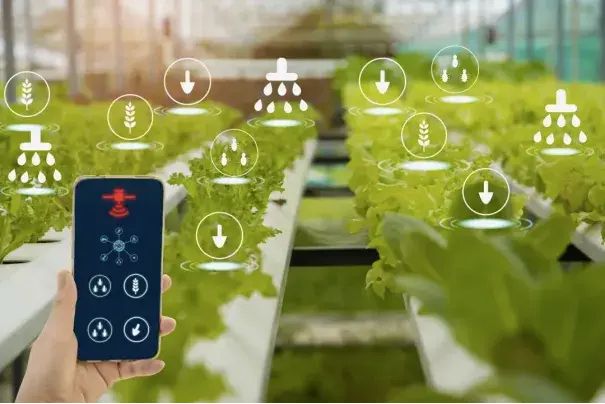
How an Automated Greenhouse Monitoring and Control System Works
Sensors feed the controller. The controller compares readings with setpoints and runs equipment in priority order. Common functions include:
- Opening roof vents or starting fans when temperature passes a setpoint
- Staging cooling when ventilation alone is not enough
- Starting heating below the night setpoint, with a dead band to stop cycling
- Adjusting screens for radiation or for heat loss
- Running lights to a DLI or photoperiod target
- Irrigating on radiation sum, substrate moisture, or time
Good logic stops systems from fighting each other. Heating and ventilation should not run against each other, fogging needs ventilation or air movement, and minimum run times protect motors from short cycling. Alarm thresholds, manual override, and a fallback mode for sensor failure belong in the specification, not in a later upgrade.
Centralized Control: When It Is Worth It
One controller that sees every zone simplifies daily operation and records the data you need for troubleshooting and crop planning. Remote access and alarm notifications reduce the cost of a night fault.
Not every project needs it. A single-span house with manual vents and one heater can run on a thermostat and a timer. Decide by zone count, labor cost, crop value, and how much of the operation you want recorded.
Before you invest: list the parameters you must control and the equipment that must respond automatically, then confirm compatibility, alarm handling, spare parts, and remote support.
How the Six Systems Work Together in an Automated Greenhouse Project
Read separately, the six systems look like a shopping list. In an automated greenhouse project they share one air volume and one control loop.
A Hot Summer Afternoon
Radiation rises, the controller opens vents, then starts fans, then stages cooling as temperature climbs. Screens close partway to cut the load, and irrigation runs on the radiation sum. Each step starts because the previous one reached its limit, so capacity cannot be decided one system at a time.
A Cold Winter Night
Screens close to hold heat, the heating circuit opens, and ventilation drops to the minimum needed for humidity and CO2. If that minimum is set too high, the heater runs all night against an open vent.
In both cases, the most expensive mistakes are coordination failures: oversized fans with undersized inlets, cooling pads shaded by a closed screen, lighting added without extra cooling capacity. A control strategy designed with the equipment prevents most of them.
Five Decisions to Settle Before You Invest
An equipment list is the last step. These five decisions determine what belongs on it.
1. Crop and Growing Requirements
Temperature, humidity, DLI, CO2, and root-zone targets come from the crop and the season you plan to produce in. Tomatoes, cucumbers, leafy greens, and ornamentals differ enough to change the equipment set. Write the targets down before you compare suppliers.
2. Local Climate
Use summer design dry-bulb and wet-bulb temperatures, winter minimum, radiation, wind, rainfall, and water availability. A hot, dry site points to evaporative cooling. A humid tropical site points to ventilation, shading, and a dehumidification strategy. A cold site points to insulation and heating capacity.
3. Greenhouse Structure and Project Size
Structure limits your options. Tunnel and Gothic greenhouses suit sidewall ventilation and simpler control, while multi-span and glass houses accept roof vents, screens, and centralized control more easily. Size drives zoning, fan counts, and pipe or duct runs.
4. Budget and Automation Level
Compare capital cost with running cost. Electricity, fuel, water, maintenance, and labor usually outweigh the purchase price difference over the life of the project. Choose the automation level you can operate and maintain.
5. Future Expansion and Compatibility
Plan control capacity for the phases you expect. Spare zones in the controller, spare circuits in the panel, and space for more fans or pads cost little at build stage and avoid rebuilding later. Include operator training and spare parts in the plan.
Frequently Asked Questions About Greenhouse Environmental Control Systems
What Are Greenhouse Environmental Control Systems?
They are the equipment and controls that keep temperature, humidity, CO2, light, water, and nutrients within the crop's range: ventilation, cooling, heating, irrigation and fertigation, lighting, and the automation that coordinates them.
How Many Control Zones Does a Commercial Greenhouse Need?
One zone for each area you want to control separately. Zones usually follow structural bays, crop blocks, and equipment capacity, because a heater or fan set that serves two different crops cannot satisfy both.
Is Fan and Pad Cooling Suitable for Humid Climates?
Only to a limited degree. Its cooling depends on how far the air is from saturation, so humid air gives a small temperature drop. In humid regions, shading, ventilation, air circulation, and dehumidification usually matter more.
Can You Add These Systems to an Existing Greenhouse?
Usually yes, but the structure sets the limit. Pads and fans need wall space and a clear air path, screens add roof load, and new equipment needs electrical capacity. Assess the existing house first.
Which System Should You Prioritize on a Limited Budget?
Start with whatever limits production at your site: summer heat, night cold, humidity, or water control. Ventilation and shading come first in hot climates, heating and insulation in cold ones. Automation can follow once the hardware works.
What Information Does a Supplier Need to Quote These Systems?
Site location and climate data, crops and target season, greenhouse type and area, water and power availability, required control level, and your expansion plan. Clear targets produce a comparable quote; vague ones produce a generic equipment list.
Final Thoughts
No single equipment set fits every commercial greenhouse. The right combination follows from your crop targets, your site climate, your structure, and the team who will run it. Settle those four, then size ventilation, cooling, heating, irrigation, lighting, and control against them.
If you are planning a new build or upgrading an existing house, our team at FZY Greenhouses can review your structure and greenhouse environmental control systems together and propose a configuration that matches your climate and crop.
Send your project location, crop, area, and control requirements, and we will come back with a system layout and equipment list.
Table of Contents
- What Do Greenhouse Environmental Control Systems Include?
- 1. Ventilation: Temperature, Humidity, and Air Exchange
- 2. Cooling: Holding Summer Temperatures Down
- 3. Heating: Stable Night Temperatures
- 4. Irrigation and Fertigation: Water and Nutrient Supply
- 5. Lighting: Natural Light, Supplemental Light, and Shading
- 6. Automation: The System That Connects the Other Five
- How the Six Systems Work Together in an Automated Greenhouse Project
- Five Decisions to Settle Before You Invest
-
Frequently Asked Questions About Greenhouse Environmental Control Systems
- What Are Greenhouse Environmental Control Systems?
- How Many Control Zones Does a Commercial Greenhouse Need?
- Is Fan and Pad Cooling Suitable for Humid Climates?
- Can You Add These Systems to an Existing Greenhouse?
- Which System Should You Prioritize on a Limited Budget?
- What Information Does a Supplier Need to Quote These Systems?
- Final Thoughts