 EN


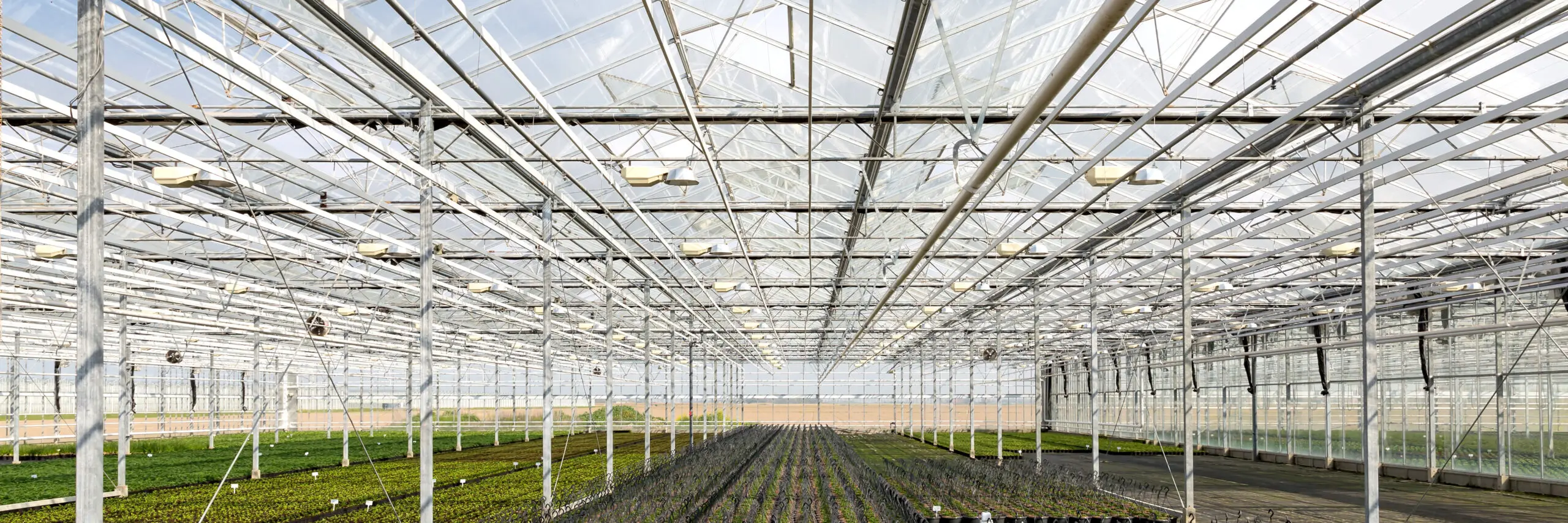
Greenhouse climate control is not five separate jobs. Temperature, humidity, light, CO2, and air movement share one air volume, so every correction you make to one of them changes the other four. This guide gives you the target for each factor, the measurement that actually steers it, and the control logic that keeps all five in balance through a working day.
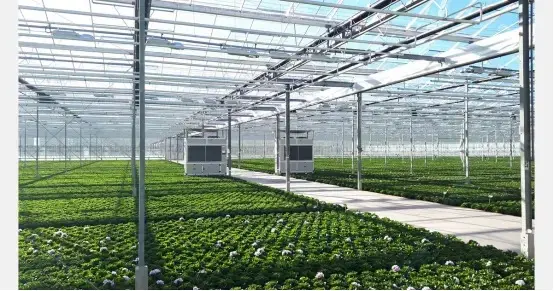
What Does Greenhouse Climate Control Mean in Practice?
Greenhouse climate control is the practice of holding five interacting variables inside a band that suits the crop, rather than holding any single number constant.
A house tuned factor by factor oscillates, because each correction arrives late and overshoots. A house tuned on the relationships between factors stays steady, because the controller knows which output has priority at that moment.
The five factors, the measurement that represents each one, and the equipment that moves it:
|
Factor |
What You Measure |
What Moves It |
|
Temperature |
Air temperature at canopy height (°C), day and night separately |
Vents, exhaust fans, heating, screens |
|
Humidity |
VPD (kPa), plus dew point against surface temperature |
Ventilation, heat plus air exchange, dehumidification |
|
Light |
DLI (mol/m²/day) and PPFD (µmol/m²/s) |
Covering transmission, screens, supplemental LEDs |
|
CO2 |
Concentration at canopy (ppm) |
Minimum ventilation, enrichment, closed-house timing |
|
Air movement |
Air speed through the canopy |
Circulation fans, vent and inlet layout |
1. Temperature: Control the Curve, Not the Number
Plants respond to accumulated warmth and to the difference between day and night, not to one setpoint. A single thermostat setting forces you to choose between wasting heat at night and losing growth by day.
Set Day and Night Targets Separately
Night temperature drives development rate and respiration, so it should be a deliberate choice per crop stage. Day temperature should follow the light actually available: on a dull day, a high day setpoint buys respiration without photosynthesis. Two setpoints and a ramp between them are enough for most commercial crops.
Give Every Output a Dead Band
Every vent, fan, and heater needs a gap between its switch-on and switch-off point. Without that dead band, a temperature sitting at the setpoint makes drives hunt continuously and shortens motor life. Minimum run times and staged fans solve the same problem from the equipment side.
Measure the Crop Zone, Not the Roof
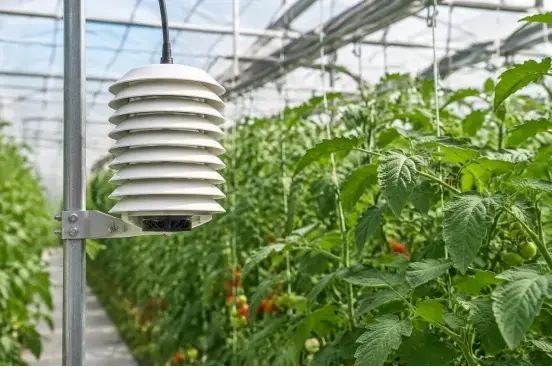
Air stratifies. A sensor at gutter height can read several degrees above the canopy, and a closed screen creates a separate climate above and below itself. Place the controlling sensor in the crop zone, in a shielded or aspirated housing, and use zone sensors rather than one average in a large multi-span house.
2. Humidity: Steer VPD and Dew Point, Not Relative Humidity
Relative humidity tells you how full the air is. It does not tell you how hard the air is pulling water out of the leaf, which is what the crop responds to. That is why the same RH reading can describe a comfortable afternoon and a stressful one.
Why the Same RH Is Two Different Environments
At 24 °C and 70% RH, vapor pressure deficit is about 0.90 kPa. At 28 °C and the same 70% RH, it is about 1.13 kPa — roughly 25% more drying force, with an identical humidity reading.
Most greenhouse crops work best in a VPD band of roughly 0.5–1.2 kPa, with fruiting vegetables usually run toward 0.8–1.0 kPa. A controller holding RH steady can therefore still let the crop run dry at midday.
Condensation Is a Surface Problem
At 20 °C and 85% RH the dew point is about 17.4 °C. Any leaf, gutter, frame, or panel colder than that will be wet, whatever the room sensor reads.
This is why unheated glass and the inner face of a closed thermal screen condense first. Raising air temperature two or three degrees, or moving air across the surface, removes the risk without opening a vent and losing the heat.
Remove Water Without Throwing Away Heat
Heating alone lowers relative humidity but leaves the same absolute moisture in the house, which condenses as soon as the heat stops. Heat plus a small continuous air exchange actually removes water. Where outside air is wetter than inside, a dehumidifier beats night venting on energy, and shifting irrigation earlier in the day removes moisture at the source.
3. Light: Manage the Daily Integral, Not the Noon Peak
A bright noon does not compensate for a short or heavily shaded photoperiod. Judge light on what the crop receives across the day, and use the peak only to decide when to shade.
DLI Is the Number to Steer By
Daily light integral is the sum of photosynthetically active light over the photoperiod. The conversion is direct: 200 µmol/m²/s for 12 hours delivers about 8.6 mol/m²/day, while 400 µmol/m²/s for 14 hours delivers about 20 mol/m²/day.
Fruiting vegetables commonly target 20–30 mol/m²/day; lettuce and herbs sit lower, around 12–17. A house that looks bright at noon is still light-limited if the effective photoperiod is short or screens stay closed.
Shade Before You Cool, but Ventilate First
Screens cannot replace cooling, but they cut the load that cooling has to remove. Close screens before ventilation only in a humid house with no airflow — that traps humid air under the screen and suppresses transpiration. Establish airflow first, then shade, and reopen the screen as soon as the load falls.
Supplemental Light Only Against a Deficit
Size LEDs for the gap between natural DLI and the crop target, not for the highest output available. Lighting also adds heat, so in a warm climate every kilowatt brings a cooling cost with it.
4. CO2: Enrich Only While the House Is Closed
Ambient air sits near 420 ppm. In a closed, actively photosynthesising house, canopy CO2 can fall well below that by mid-morning, and photosynthesis becomes the limiting process even when light and temperature are right.
When Enrichment Pays Back
Most enrichment strategies hold 700–900 ppm while vents are shut. The economics depend on timing: enrich in the early morning and late afternoon when the house is closed, and stop when the crop is heat-stressed, because closed stomata mean the gas is paid for and not absorbed.
Above roughly 1,000 ppm the marginal gain flattens while the safety margin narrows.
Ventilation and CO2 Compete for the Same Air
Once roof vents open for temperature control, added CO2 leaves faster than the crop can fix it, and the cost per retained ppm rises sharply.
A practical rule: pause enrichment as soon as vents pass a small opening, and on a hot day let temperature win — a crop at 35 °C will not use the extra carbon anyway.
Where the CO2 Comes From
Three supply routes matter at project stage: a dedicated gas supply, a boiler or burner with a clean flue connection, and liquid CO2 delivered to site. Each has a different cost structure and a different safety requirement.
Whatever the source, a CO2 sensor inside the house and an alarm are part of the system, not accessories — enrichment hardware without monitoring is a risk you cannot see.
5. Air Movement: Make One Sensor Tell the Truth
Still air lets temperature, humidity, and CO2 stratify into layers your sensor never samples. Air movement is the cheapest way to make one reading represent the whole house.
Ventilation and Circulation Do Different Jobs
Ventilation exchanges indoor air with outside air, which changes heat, moisture, and CO2 at the same time. Circulation mixes air inside the house without exchanging it, evening out temperature and humidity and keeping the boundary layer around leaves from saturating. Circulation cannot substitute for ventilation; a house with strong mixing and closed vents still overheats.
Where Airflow Fails in Commercial Houses
Dense canopies, tall gutter heights, and dead corners at gable ends are where the reading and the crop disagree. The target is gentle, steady movement through the canopy — enough to move leaves slightly, not enough to flatten them — with inlet and outlet positions designed as one air path rather than two separate decisions.
What Moves the Air
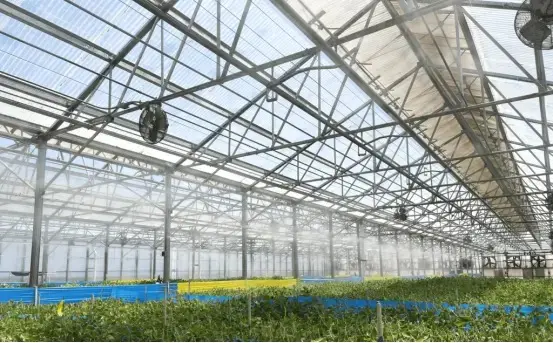
Horizontal airflow fans are the usual choice in the crop zone, arranged to push air along the rows rather than across them. Perforated air tubes serve the same purpose in tall or dense crops, delivering air where a wall-mounted fan cannot reach.
Whichever you use, the gap between the top of the canopy and a closed screen is where still, saturated air collects, so that band needs its own movement.
How the Five Factors Interact
A control action that fixes one factor usually charges another, and that is where most greenhouse climate control problems begin. The table below is the set of trade-offs that decides whether your settings work in practice.
|
Control Action |
Helps |
Costs You |
How to Coordinate |
|
Open roof vents |
Temperature, humidity |
CO2, heating energy |
Pause enrichment; stage heating so it does not fight the vent |
|
Close screens |
Heat load, light level |
Humidity under the screen, light |
Ventilate below the screen first; reopen early |
|
Heat at night |
Temperature, RH reading |
Energy; moisture stays in the air |
Pair with minimum air exchange |
|
Fog or mist |
Air temperature |
Humidity, leaf wetness |
Require air movement; stage against VPD |
|
Enrich CO2 |
Photosynthesis |
Gas cost |
Only while the house is closed |
In practice the day has a rhythm. At sunrise, heating and screens hand over to ventilation as the temperature climbs, and enrichment stops once vents open. At sunset the sequence reverses: screens close, heating takes over, and the risk moves from heat to condensation on the coldest surface in the house.
Greenhouse Controllers: Where Climate Control Becomes Automatic
Manual operation works in a small single-span house with one crop. It stops working when several zones, crops, and outputs have to respond to the same weather change within minutes.
What a Controller Actually Does
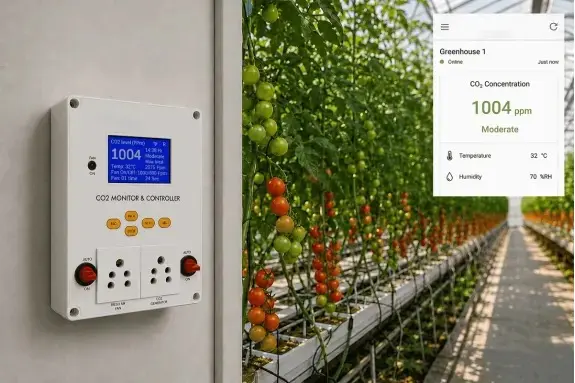
Greenhouse controllers read sensors, compare the readings with setpoints, and operate outputs in a priority order you define. Three settings decide whether the result is stable: the dead band on each output, the minimum run time, and which system has priority when two of them want to act at once.
Without a priority order, heating and ventilation will run against each other and the energy bill shows it.
Sensor Placement Decides the Result
A sensor inside the canopy reads leaf-zone conditions; a sensor in the roof zone reads the air being exhausted. A controller configured for one and installed in the other will hold the wrong setpoint all season.
Use shielded sensors in the crop zone, one per control zone, and calibrate RH and CO2 sensors on a schedule — drifting sensors keep logging confident numbers.
Three Levels of Control
|
Level |
Typical Equipment |
Fits |
|
Thermostat and timer |
One fan, one heater, manual vents |
Small tunnel house, single crop, short season |
|
Multi-zone controller |
Vents, fans, heat, screens by zone |
Mid-size multi-span house, two to four crops |
|
Climate computer |
Full coordination, CO2, DLI, remote access, logging |
Year-round production, high crop value, several zones |
Full integration is not automatically the right answer. Three conditions justify it: crop value per square meter high enough that a lost week matters, a local climate with swings manual operation cannot follow, or year-round production with several crops where the coordination between heat, vents, and CO2 sets the energy bill.
Where none of those apply, spend the budget on structure, covering, and vent area first.
Greenhouse Environmental Control Systems: The Hardware Behind the Setpoints
The setpoints above only work if the equipment can reach them. Greenhouse ventilation systems exchange air; cooling systems and heating systems hold temperature when exchange alone is not enough; screens, lighting, and irrigation adjust the remaining variables; and the controller ties them together.
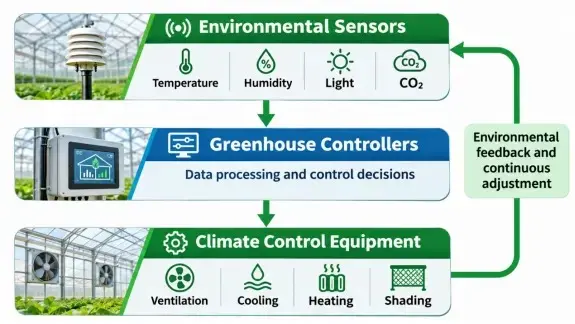
Which of those systems earns the investment is decided by the constraint that dominates your site, not by the equipment list. A hot, dry site needs evaporative cooling capacity; a humid one needs air exchange and dehumidification; a cold one needs insulation and heat. Sizing those capacities is a calculation against design conditions, not a catalog choice.
This article covers the targets and the control logic. The composition of those systems, how their capacities are sized, and which configuration suits which climate are covered in our guide to greenhouse environmental control systems.
Five Configuration Mistakes That Undo Good Equipment
Most underperforming greenhouse climate control systems are not missing equipment. They are configured so that two systems cancel each other, and these five errors appear repeatedly.
- Controlling relative humidity instead of drying force. A controller holding 80% RH holds two different environments in winter and in summer. Set a VPD band, or at least a temperature-dependent RH ceiling.
- Enriching CO2 with the vents open. The gas leaves before the crop can fix it, and the grower concludes that enrichment does not work on this crop.
- Heating at night without removing moisture. Air temperature rises, relative humidity falls, and the same absolute moisture condenses on the coldest surface when heating stops.
- Sizing cooling by floor area alone. Check capacity against the design solar load, the target air exchange rate, and the acceptable temperature rise above outdoor.
- Using shade as a substitute for ventilation. Closing screens first traps humid air and produces soft growth. Establish airflow, then shade.
A Three-Step Tuning Sequence for a New Greenhouse
New systems are usually commissioned in the wrong order, which is why the first season feels like constant adjustment. Work through these three steps and most of that disappears.
Step 1: Verify the Measurement
Before you change a single setpoint, confirm that each sensor reads what you think it reads. Compare the canopy sensor against a handheld meter at midday and at night, check that the aspirated box is actually drawing air, and log one full day of temperature, VPD, and CO2 before touching the controller.
Step 2: Fix Priorities, Then Numbers
Decide the order of operations first: on a rising temperature, which stage opens at which value, what happens to enrichment, and where the screen sits in that sequence. Only then set the numbers. A correct priority order with approximate setpoints outperforms precise setpoints in an undefined sequence.
Step 3: Tune One Factor per Week
Change one band at a time and watch the crop response for several days. Adjusting temperature, humidity, and CO2 together makes it impossible to attribute the result, and it is the most common reason growers give up on a controller and return to manual operation.
Frequently Asked Questions About Greenhouse Climate Control
What Are the Five Main Factors Affecting Greenhouse Climate?
Temperature, humidity, light, CO2 concentration, and air movement. They drive photosynthesis, transpiration, development, and the uniformity of the growing environment, and they have to be managed together because a correction to one changes the others.
What Is the Difference Between Climate Control and Environmental Control Systems?
Climate control is the process: deciding the targets and the logic for holding them. Greenhouse environmental control systems are the equipment that carries it out — ventilation, cooling, heating, irrigation, lighting, sensors, and controllers.
How Do Greenhouse Controllers Work?
They read sensors, compare readings with setpoints, and switch outputs in a priority order. The dead band, minimum run time, and priority settings matter more than the brand of the panel, because they decide whether equipment cycles or settles.
What VPD Should I Target?
Most greenhouse crops work in a band of roughly 0.5–1.2 kPa. Propagation and young plants sit at the low end; fruiting vegetables usually run 0.8–1.0 kPa. Steer by VPD together with temperature, and treat relative humidity as a secondary check.
Is CO2 Enrichment Worth It?
Only if the house can stay closed while the crop is photosynthesising and the crop value covers the gas. If vents are open most of the day, the added CO2 leaves before it is used, and ventilation for temperature should take priority.
Does Climate Control Have to Be Fully Automated?
No. A single-span house with one crop can run on thermostats, timers, and manual vents. Automation earns its cost with multiple zones, high-value crops, frequent weather swings, or equipment that must be coordinated rather than operated one at a time.
Final Thoughts
Climate control is a set of trade-offs, not a list of setpoints. Fix the measurement first — canopy temperature, VPD, dew point against surface temperature, DLI, and CO2 at the crop — then give each output a dead band and a priority.
If you are planning a new house or re-tuning an existing one, our team at FZY Greenhouses can review your targets alongside the greenhouse controllers you are considering, and point out where the configuration will fight itself.
Table of Contents
- What Does Greenhouse Climate Control Mean in Practice?
- 1. Temperature: Control the Curve, Not the Number
- 2. Humidity: Steer VPD and Dew Point, Not Relative Humidity
- 3. Light: Manage the Daily Integral, Not the Noon Peak
- 4. CO2: Enrich Only While the House Is Closed
- 5. Air Movement: Make One Sensor Tell the Truth
- How the Five Factors Interact
- Greenhouse Controllers: Where Climate Control Becomes Automatic
- Greenhouse Environmental Control Systems: The Hardware Behind the Setpoints
- Five Configuration Mistakes That Undo Good Equipment
- A Three-Step Tuning Sequence for a New Greenhouse
- Frequently Asked Questions About Greenhouse Climate Control
- Final Thoughts