 EN


Yes. Greenhouse covering materials trap heat, while crop transpiration and irrigation add moisture to the air. If air exchange is insufficient, the greenhouse can develop excessive heat and humidity, condensation, and low carbon dioxide levels. These conditions can affect flowering, fruit set, disease pressure, and crop uniformity. The goal of ventilation is not to create as much airflow as possible, but to keep temperature, humidity, and air quality within a range suitable for crop growth.
1. What Does Greenhouse Ventilation Do?
1. Remove Excess Heat
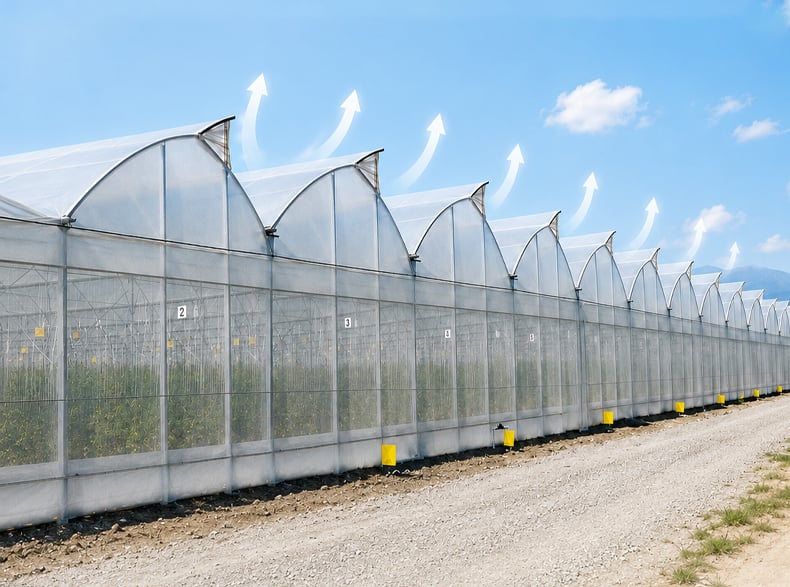
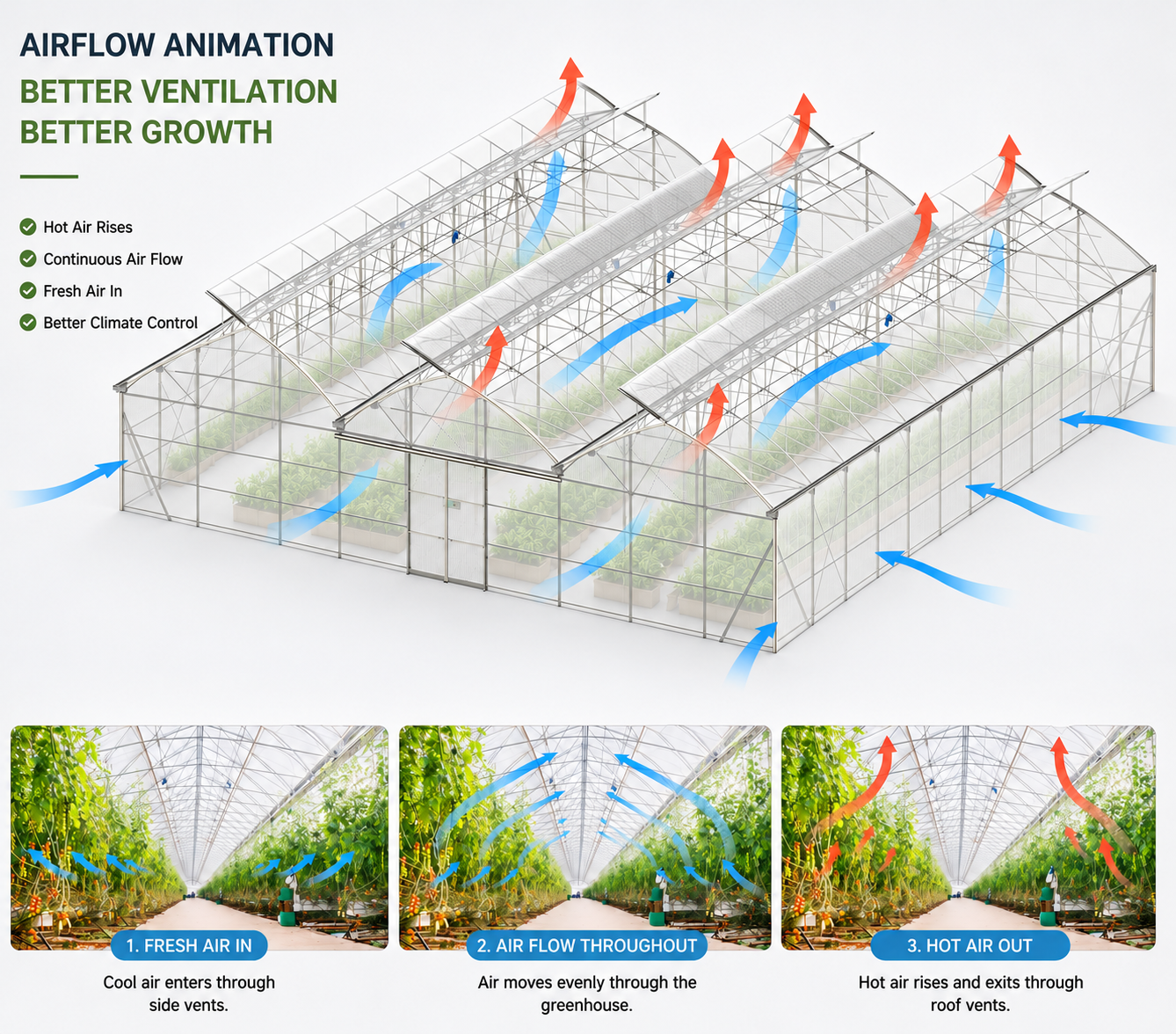
On sunny days, solar radiation heats the air, soil, growing media, and plant surfaces. Roof and side vents help release hot air and bring in cooler outdoor air.
2. Manage Humidity and Condensation
Crop transpiration, irrigation, and evaporation add water vapor to the greenhouse. Proper air exchange can reduce moisture buildup and prolonged leaf wetness. However, in hot and humid regions, outdoor air itself may contain a high amount of moisture, so ventilation alone may not be sufficient.
3. Replenish Carbon Dioxide
Photosynthesis consumes carbon dioxide around the crop canopy. When the outdoor CO₂ concentration is higher than the indoor concentration, air exchange helps replenish fresh air. If CO₂ enrichment is used, its operating schedule should be coordinated with ventilation to avoid unnecessary CO₂ loss.
4. Improve Environmental Uniformity
Ventilation provides air exchange between the greenhouse and the outdoors, while circulation fans mainly move air within the greenhouse. Used together, they can reduce hot spots, humid areas, and stagnant-air zones. However, circulation fans cannot replace fresh-air exchange.
2. What Are the Signs of Insufficient Ventilation?
- The greenhouse temperature rises rapidly on sunny days;
- Condensation frequently forms on the covering materials or leaves;
- Temperature and humidity vary significantly between different areas;
- Leaves remain wet for long periods and diseases recur;
- Plants in the same crop batch show inconsistent growth, flowering, or fruit size.
Temperature and humidity sensors should be installed at crop-canopy height and in both the central and edge areas of the greenhouse. A single sensor near the entrance usually cannot represent the overall environment in a large greenhouse.
3. Common Greenhouse Ventilation Methods
|
System |
Main Function |
Applications and Limitations |
|
Roof ventilation |
Uses rising hot air to remove accumulated heat from the greenhouse |
Suitable for natural ventilation; performance depends on vent area, wind direction, and greenhouse structure |
|
Side ventilation |
Supplies outdoor air through the sides of the greenhouse |
Can work with roof vents to create an air-inlet and exhaust path; insect screens increase resistance |
|
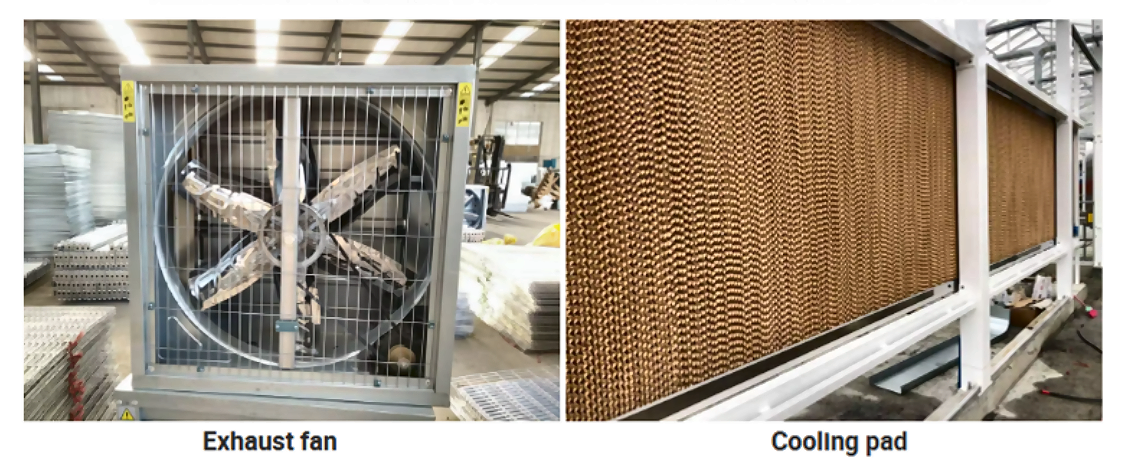
Exhaust fans |
Actively remove hot air and provide mechanical air exchange |
Must be matched with air inlets, greenhouse dimensions, required airflow, and local power conditions |
|
Fan-and-pad system |
Combines mechanical ventilation with evaporative cooling |
Usually more effective in hot, dry climates; cooling capacity is limited in humid regions |
|
Circulation fans |
Move air inside the greenhouse to reduce dead zones and temperature and humidity differences |
Cannot directly provide air exchange between indoors and outdoors |
4. When Might Natural Ventilation Be Insufficient?
- The greenhouse is long or wide, resulting in noticeable stagnant-air zones;
- High summer temperatures and low wind speeds make it difficult to cool the greenhouse, even at night;
- Dense insect screens significantly increase air-inlet resistance;
- Tall and dense crop canopies make it difficult to remove moisture;
- The project requires continuous production during hot seasons.
Under these conditions, consider a combination of roof ventilation, side ventilation, circulation fans, exhaust fans, cooling pads, or shading systems. The final solution should be calculated according to the greenhouse structure, crops, and local climate, rather than simply adding one type of equipment.
5. How to Choose a Ventilation System
|
Design Factor |
Information to Confirm |
|
Local climate |
Maximum temperature, humidity, wind speed, prevailing wind direction, and seasonal variations |
|
Crops and planting density |
Crop type, canopy height, transpiration rate, and disease susceptibility |
|
Greenhouse structure |
Type, length, width, height, and covering materials |
|
Effective vent openings |
Roof and side vent areas, insect-screen resistance, and vent locations |
|
Mechanical equipment |
Actual fan airflow, air-inlet area, and cooling pad or fogging conditions |
|
Energy and control |
Voltage, available electrical capacity, sensors, automatic controls, and operating costs |
In hot, dry regions, consider combining natural ventilation with evaporative cooling. In hot and humid regions, priority should be given to improving air-exchange efficiency. Use fogging cautiously to avoid increasing humidity further.
6. Greenhouse Ventilation Requires an Integrated Design
Ventilation is not a standalone piece of equipment. Roof vents remove heat, side vents supply fresh air, shading reduces solar heat gain, and circulation fans improve air uniformity inside the greenhouse. Fan-and-pad or fogging systems provide cooling in specific climates, while the climate controller coordinates the equipment. A stable growing environment can be achieved only when these systems are matched to the crops and local climate.
7. Conclusion
Greenhouses need ventilation, but no single system is suitable for every project. Before design begins, provide the greenhouse dimensions and structure, local temperature, humidity and wind conditions, target crops, covering materials, insect screens, existing cooling equipment, and energy supply conditions. These inputs are then used to determine the right combination of natural ventilation, mechanical ventilation, and air circulation.
Table of Contents
- 1. What Does Greenhouse Ventilation Do?
- 1. Remove Excess Heat
- 2. Manage Humidity and Condensation
- 3. Replenish Carbon Dioxide
- 4. Improve Environmental Uniformity
- 2. What Are the Signs of Insufficient Ventilation?
- 3. Common Greenhouse Ventilation Methods
- 4. When Might Natural Ventilation Be Insufficient?
- 5. How to Choose a Ventilation System
- 6. Greenhouse Ventilation Requires an Integrated Design
- 7. Conclusion